Chat with us
1

Precision Underfoot: Why 3D Modeling is the Secret to Perfect Calepinage

5 min read
Precision Underfoot: Why 3D Modeling is the Secret to Perfect Calepinage

In the final stages of a construction project, the difference between a "good" finish and a "luxurious" one lies in the details of the surfaces. The Plan de Calepinage (Tiling Layout Plan) is the technical blueprint that dictates exactly how tiles, marble, or stone slabs are arranged on a floor or wall. At Buildmodeler 3D, we understand that even the most expensive material can look mediocre if laid poorly. This is why we integrate 3D Modeling to master the geometry of every surface before a single tile is cut.

What is a Calepinage Plan? The Calepinage is a specialized part of the DCE phase. It is much more than just a "flooring plan." It is a mathematical organization of the surface that defines:

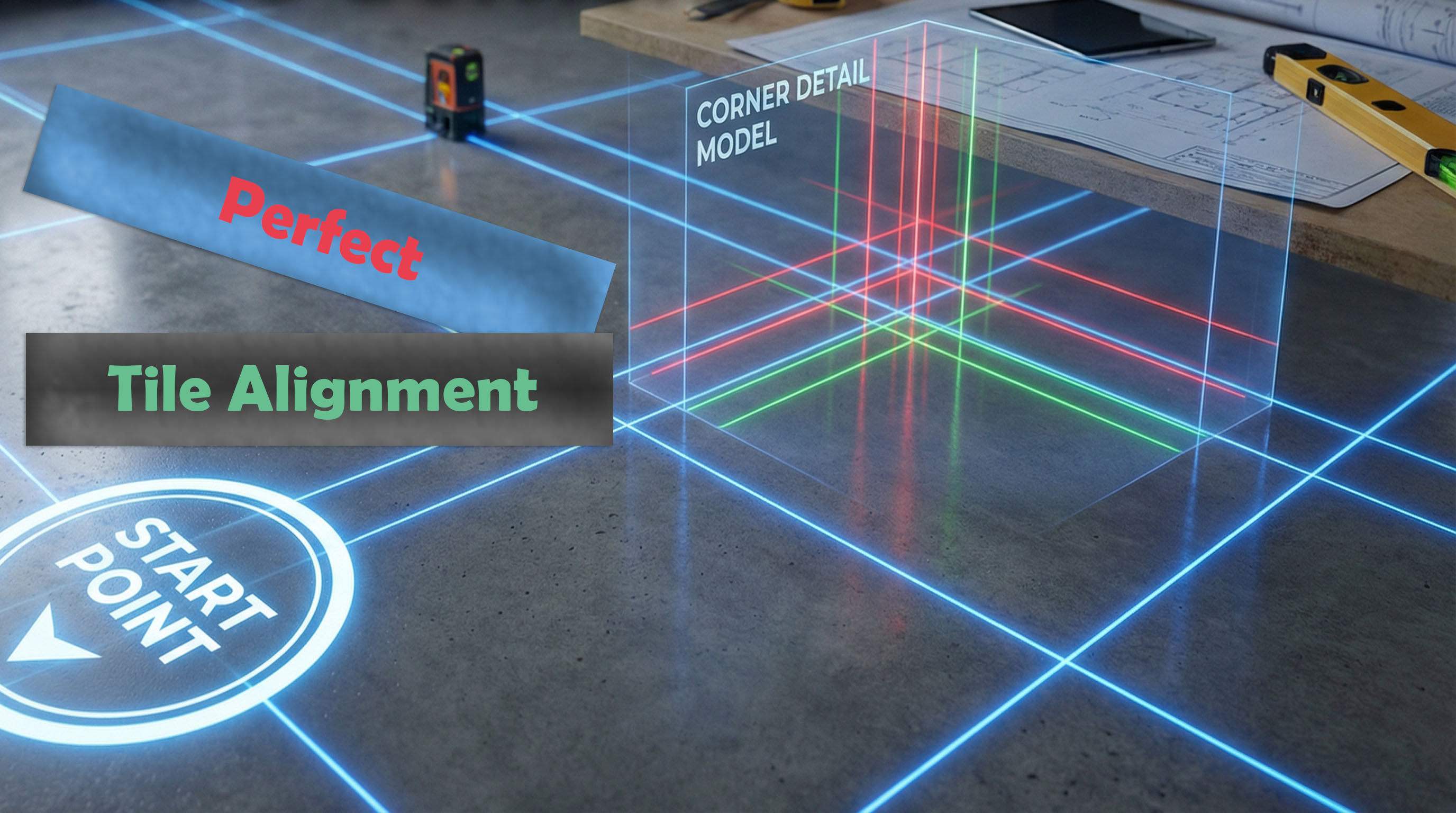
1. The Starting Point (Le Point de Départ): Deciding where the first full tile is placed to ensure symmetry.
2. Joint Management: Defining the thickness and color of the joints between tiles.
3. The Pattern: Whether it is a straight lay, diagonal, herringbone, or a complex custom mosaic.
4. Waste Optimization: Planning cuts in less visible areas to minimize material loss.

The Nightmare of Bad Planning Without a professional Calepinage plan, contractors often start tiling from a random corner. This leads to "slivers" or very thin, ugly strips of tile at the most visible entrances or against main walls. For expensive materials like large-format porcelain or natural marble, these mistakes are not just aesthetic failures—they are financial disasters.

Why 3D Modeling is Essential for Calepinage Traditional 2D plans can show the "grid," but 3D Modeling provides a realistic and functional preview that changes everything:

5. Visualizing the "Whole" Picture: In 3D, you can see how the floor pattern aligns with the wall features, doors, and furniture. We can ensure that a joint in the floor lines up perfectly with a "Joint Creux" in the ceiling or the edge of a kitchen island.
6. Real-World Material Simulation: We use the exact dimensions of your chosen tile in the 3D model. If you are using a 120x60cm slab, we model it precisely. You can see how the natural veins of a marble slab will flow across the room, allowing for "Book-matching" simulations where the patterns connect beautifully.
7. Eliminating On-Site Guesswork: By providing the contractor with a 3D-generated Calepinage plan, there is no room for interpretation. The workers know exactly where to start and where the cuts will occur, ensuring the final result is exactly as designed.
8. Accurate Costing and Ordering: 3D software provides an exact count of full tiles and the specific dimensions of cut pieces. This allows for an ultra-precise order, saving you from paying for 15-20% extra "safety" stock that often ends up as waste.

Conclusion The Calepinage Plan is the final touch of engineering for your surfaces. By leveraging Advanced 3D Modeling, you transform a standard tiling job into a work of geometric art. It provides the installer with a clear roadmap and the owner with a photorealistic guarantee of quality, ensuring that every line and every joint contributes to a perfect architectural finish.

Discover more articles

Explore our collection of articles on 3D modeling and architecture.