Chat with us
1

The Architectural Compass: Why Key Plans are the Backbone of Technical Coordination

5 min read
The Architectural Compass: Why Key Plans are the Backbone of Technical Coordination

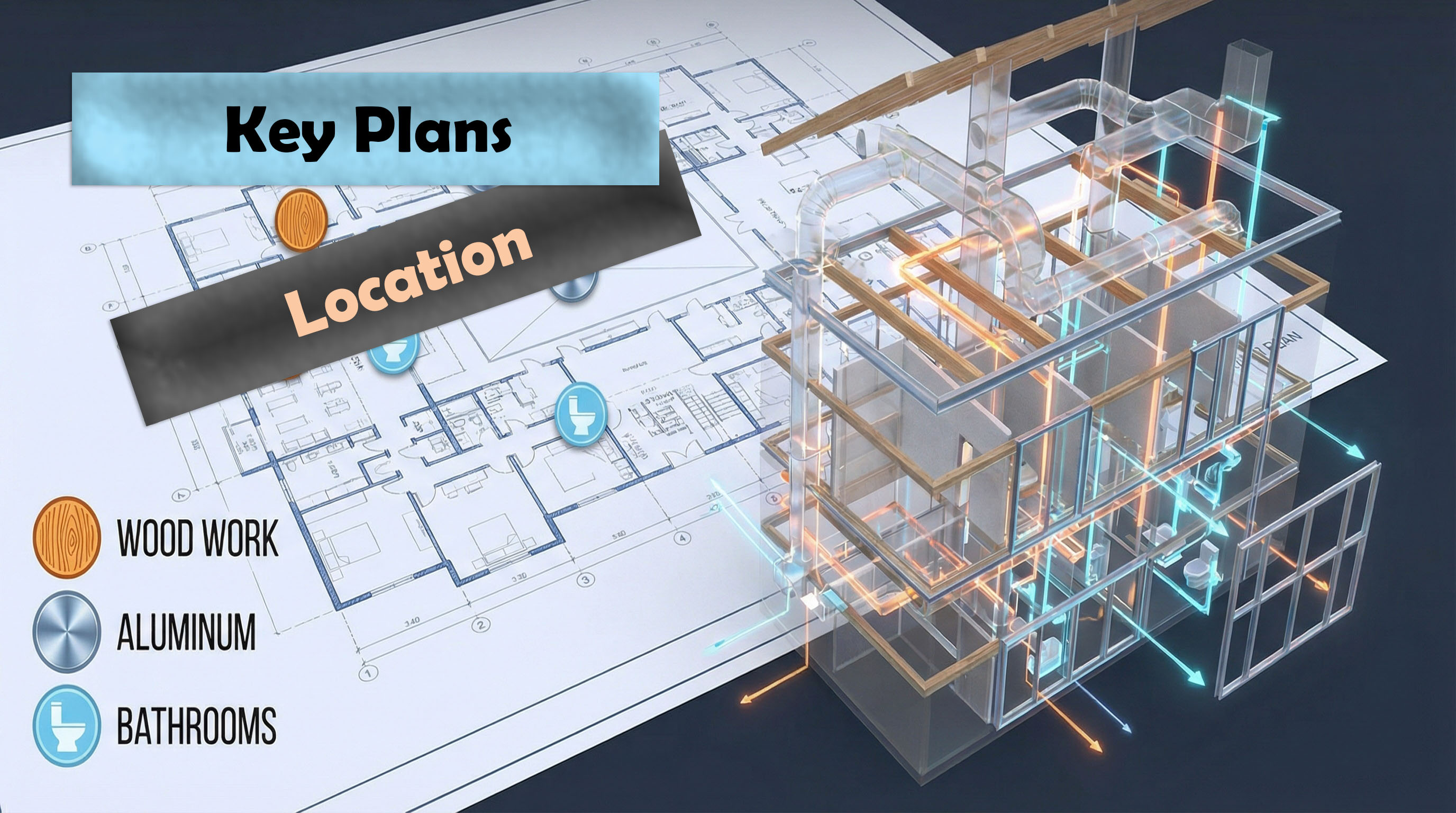
In a complex construction project, accuracy is not just about measuring a single wall; it is about knowing exactly where every specialized element is located across the entire site. This is the primary function of the Plan de Repérage (Key Plan or Localization Plan). It acts as a universal reference that accompanies all other technical documents, ensuring that every contractor knows exactly where their specific work begins and ends. At Buildmodeler 3D, we enhance this coordination by using 3D Modeling to create a unified digital map of your project.

What is a Key Plan (Plan de Repérage)? A Plan de Repérage is a strategic architectural drawing used during the DCE and EXE phases. It serves as an "index" or "map" for specialized works. You will find a Key Plan accompanying various technical dossiers, such as:

1. Flooring (Revetement): Locating different types of marble or tiles across rooms.
2. Aluminum Joinery: Mapping the position and reference number of every window and sliding door.
3. Woodwork: Identifying the exact location of custom doors, panels, and libraries.
4. Bathrooms (SDB): Pinpointing the location of specialized moisture-resistant zones.

The Risk of Fragmented Information Without a centralized Key Plan, a project becomes a collection of isolated ideas. An electrician might install a switch exactly where a wooden panel is supposed to be placed, or a tiler might start their pattern in a way that conflicts with the aluminum door tracks. These "coordination clashes" lead to expensive rework and significant delays on the construction site.

Why 3D Modeling is Essential for Localization and Key Plans Integrating 3D Modeling into the repérage process transforms these static maps into a dynamic, error-proof system:

5. The Master Digital Twin: In 3D, we don't just draw symbols; we place the actual 3D components in their exact global coordinates. This creates a "Digital Twin" where you can see how the aluminum frames interact with the wooden panels and the tiled floors simultaneously.
6. Clash Detection and Spatial Logic: Our 3D model allows for "Global Coordination." We can detect if a bathroom fixture is misplaced relative to the ceiling lighting or if a wooden door frame interferes with a specific wall finish. Solving these localization issues in 3D is 100% cheaper than solving them during construction.
7. Millimeter-Precision Reference: By extracting Key Plans directly from a 3D model, we ensure that every localization point is mathematically accurate. The contractor doesn't have to "guess" the location; they follow a 3D-validated coordinate that aligns with the structural reality of the building.
8. Simplified Communication on Site: A 3D Key Plan provides a visual "Table of Contents" for the project. Site managers can use 3D views to orient themselves and their teams, ensuring that the right materials are delivered to the right locations at the right time.

Conclusion The Plan de Repérage is the invisible thread that holds a project together. By leveraging Advanced 3D Modeling, you transform a simple map into a sophisticated coordination tool. It provides the security of technical harmony and the clarity of a unified vision, ensuring that every element of your building is placed with absolute precision and professional excellence.

Discover more articles

Explore our collection of articles on 3D modeling and architecture.