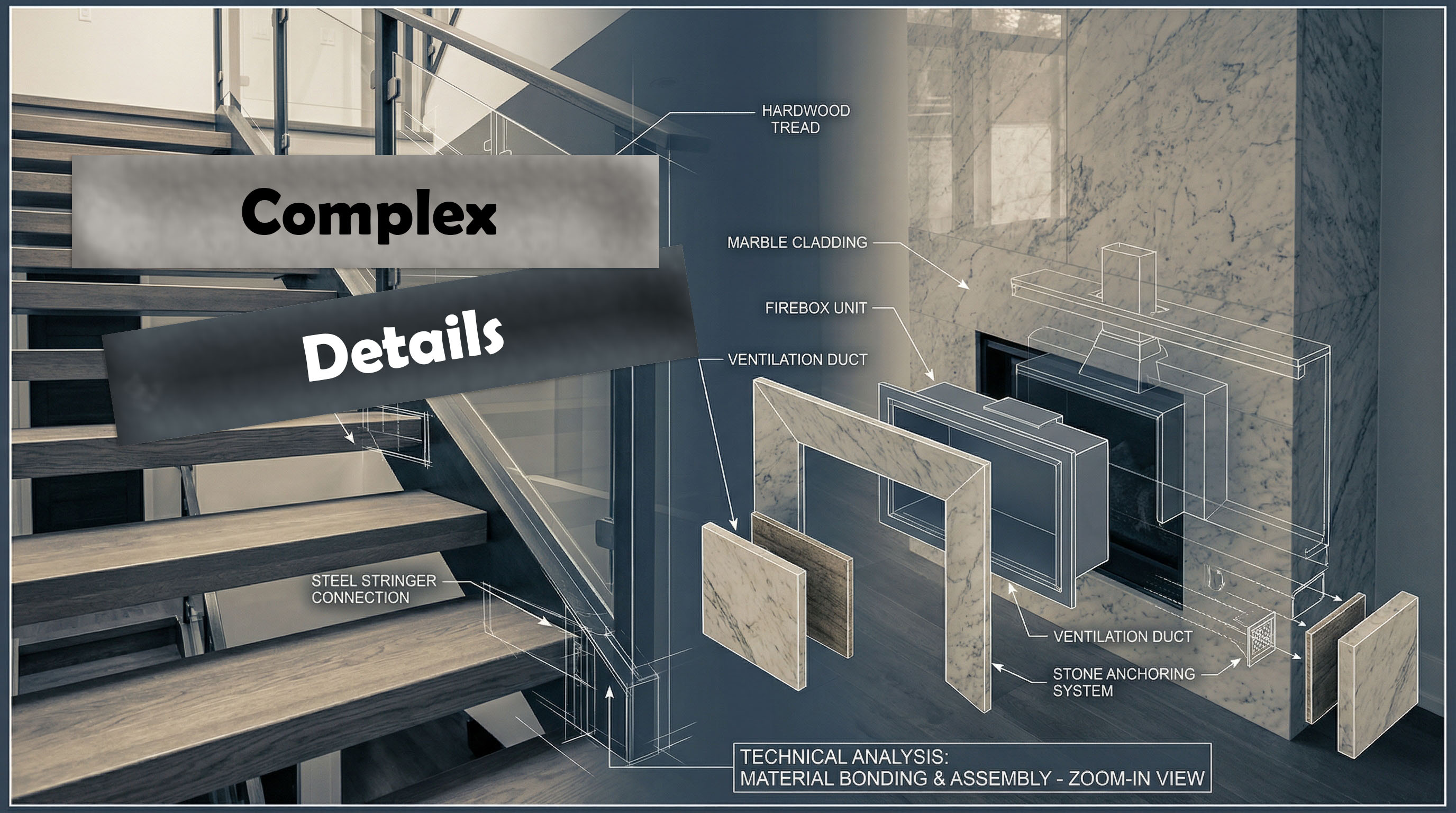
In any construction project, the difference between a standard build and a masterpiece lies in the "Details." While general plans provide the layout, the Plan de Détails (Detail Plan) focuses on the most complex and sensitive elements of the project. Whether it is a grand staircase, a bespoke fireplace, or a high-end reception counter, these elements require a level of precision that goes beyond standard drafting. At Buildmodeler 3D, we believe that 3D Modeling is the ultimate tool to visualize and engineer these intricate components before they reach the construction site.
What is a Detail Plan? The Plan de Détails is a specialized part of the DCE (Technical Dossier) phase. It provides a "close-up" view of architectural features that cannot be fully explained in general floor plans. Common examples include:
1. Staircases (Escaliers): Detailing the structure, tread materials, railings, and the complex connection points between levels.
2. Fireplaces (Cheminées): Designing the internal structure, heat insulation, and external decorative finishes.
3. Custom Counters (Comptoirs): Creating unique reception desks or kitchen islands with integrated storage and lighting.
4. Facade Junctions: Detailing how different materials like glass, metal, and stone meet at the edges of a building.
The Complexity of Custom Elements Custom-made elements are the most common source of errors on a construction site. A staircase that doesn't align with the floor above, or a fireplace that interferes with a structural beam, can lead to massive delays and wasted budgets. Traditional 2D "sections" often fail to show the three-dimensional reality of how these components fit into the surrounding space.
Why 3D Modeling is Essential for Detail Planning Integrating 3D Modeling into the detail phase transforms a design challenge into a technical certainty:
5. Digital Prototyping (Maquette Numérique): In 3D, we build a "Digital Twin" of the complex element. We can rotate it, look inside it, and verify every joint and measurement. This allows us to solve structural puzzles digitally, ensuring that when the element is built on-site, it fits perfectly like a piece of a puzzle.
6. Material Interaction Analysis: Complex details often involve multiple materials (e.g., a glass railing meeting a wooden step). 3D rendering allows you to see how these materials interact visually and physically. You can verify if the reflection of the glass or the grain of the wood works within the overall design before any material is purchased.
7. Clash Detection in Tight Spaces: Details often house hidden technical equipment like LED drivers, ventilation pipes, or structural supports. A 3D model allows for "X-ray vision," ensuring that the beautiful exterior of a counter or a fireplace doesn't clash with the technical networks hidden within it.
8. Enhanced Communication with Craftsmen: Providing a blacksmith or a stone mason with a 3D-generated detail plan is much more effective than a flat drawing. It eliminates ambiguity, ensuring the craftsman understands the 3D volume they are expected to build, which results in a much higher quality of finish.
Conclusion The Detail Plan is the signature of professional engineering. By leveraging Advanced 3D Modeling, you take control of the most difficult parts of your project. It provides the security of technical feasibility and the clarity of visual perfection, ensuring that the "complex" parts of your building become its most beautiful features.